

![[RECIPE] Bio Ramen with Chicken and Peanut Sauce #13](/img/deotemplate/blog/1/blog/41/41.png)

Collagen Supplementation – How It Works, What Forms Exist, and Why It’s Worth It?
Collagen is one of the key proteins in the body, responsible for the elasticity and strength of skin, hair, nails, as well as connective tissues and joints. Its natural production decreases with age, which is why it is worth supporting the body with proper supplementation.
In this article, we explain how collagen works, what its types and forms are, and offer guidance on how to choose products that best support health and beauty.
Table of Contents
- What collagen is and why it is important
- Benefits of collagen supplementation
- Types of collagen
- Forms of collagen
- Beef vs. fish collagen – which to choose
- How to increase supplementation effectiveness
- Summary
- Sources
What collagen is and why it is important
Collagen is the most important structural protein in the human body – it constitutes about 30% of the total protein pool. It forms a “scaffold” for tissues and is responsible for their strength, elasticity, and regenerative capacity.
Collagen is found in, among others:
- skin
- bones
- joints
- tendons and ligaments
- connective tissue
- blood vessels
- hair and nails
After the age of 25, natural collagen synthesis gradually decreases (on average by 1–1.5% per year), which may lead to deterioration of skin condition, weakening of the musculoskeletal system, and reduced tissue elasticity.
Benefits of collagen supplementation
✅ Skin
- improved firmness and elasticity
- better hydration
- reduction of fine wrinkles
- support for regenerative processes
✅ Musculoskeletal system (joints, tendons, ligaments)
- support for connective tissue strength
- improved movement comfort
- reduced feeling of stiffness
- prevention of overload injuries
✅ Hair, nails, and intestines
- strengthening hair and nail structure
- reducing brittleness
- support for intestinal barrier integrity
Types of collagen
Type I
- Main structural collagen in the body (approx. 90%)
- Skin, bones, tendons, ligaments, fascia, connective tissue, hair, nails
Type II
- Articular cartilage and joint surfaces
Type III
- Elastic tissues, blood vessels, skin (coexists with Type I)
In practice: Type I collagen is crucial for both beauty and the musculoskeletal system, while Type II acts more selectively – mainly on articular cartilage.
Forms of collagen
Native collagen (undernatured)
- not hydrolyzed
- high molecular weight (~300 kDa)
- low bioavailability
- mainly used in intestinal and immunological preparations
Hydrolyzed collagen (collagen hydrolysate)
- broken down into shorter peptide chains
- high bioavailability
- molecular weight: 3–8 kDa
- most commonly used in dietary supplements
Collagen peptides
- very short amino acid chains
- molecular weight often <3 kDa
- rapid and efficient absorption
Granulated collagen
- physical form (granules)
- easy to use
- does not affect bioavailability, only supplementation comfort
Beef vs. fish collagen – which to choose
🐟 Fish collagen – highest bioavailability
Fish collagen is considered one of the most easily absorbed forms of collagen, mainly due to its lower peptide molecular weight.
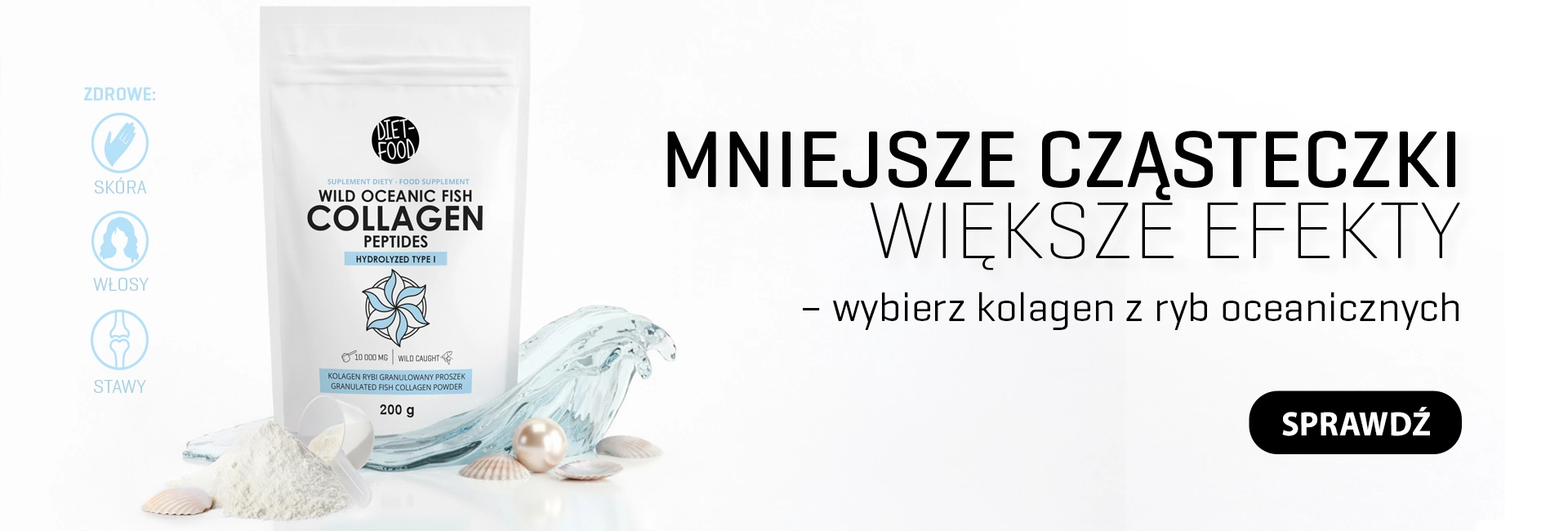
DIET-FOOD Fish Collagen 200 g is a premium product:
- ✅ Hydrolyzed Type I fish collagen
- ✅ Sourced from wild fish from clean ocean areas
- ✅ High raw material purity and excellent bioavailability
- ✅ Neutral taste and odor
- ✅ Measuring scoop included – convenient and precise dosing
Type I collagen:
- supports skin
- strengthens tendons, ligaments, and connective tissue
- beneficial for bones and musculoskeletal system
- forms the basis of anti-aging supplementation
👉 See product: Hydrolyzed Fish Collagen 200 g
Same category
- Organic Ceylon Cinnamon DIET-FOOD – authentic flavor and safety
- DIET-FOOD Creatine Monohydrate – pure strength, convenience, and support for the brain.
- The Best Organic Breakfast Sets – a Healthy Start for Everyone
- Organic Nut Butters from Diet-Food – Pure Pleasure Without Compromise
- Matcha Latte Keto Friendly – Natural Energy in Keto Style
Comments
No comment at this time!
Leave your comment